Cailyn Hansen
be bold, take risks, make changeUpdated: Feb. 19, 2026
Embracing the Occult; Rejecting the Rational: An open inquiry into esotericism, ritual, and the politics of knowing
This is a gathering, not a class; a temporary autonomous space for unlearning mastery and studying hidden lineages in community.
Description
"Embracing the Occult; Rejecting the Rational" provides participants with the foundation to understand core themes in esotericism while challenging common preconceived ideas around rationality and reason. The course begins with a primer on the study of esotericism and key themes around the Occult before exploring a range of Winter Solstice traditions. These traditions will be explored and analyzed through a critical lens while also providing partipants opportunities for practical application. It also covers the advent of Enlightenment and its disruption of esoteric beliefs. The course is also critical of the connection between fascism and the occult. Upon completion of this course, participants will be prepared to take further emic coursework in subjects such as witchery, tarot, alchemy, astrology, and magick; or etic classes like "History of Magick" and "Critical Epistemology: Exploring the 'How' to Knowing" which we encourage participants to make real.
Schedule
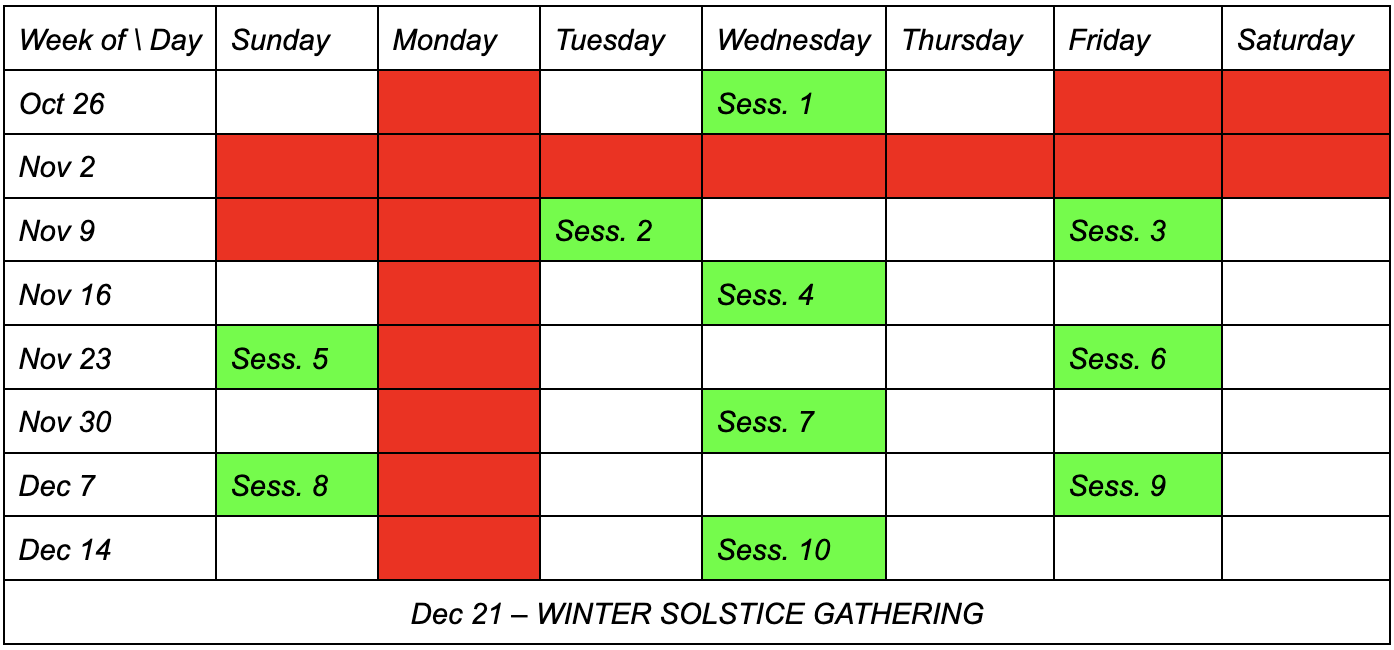
Sundays: 3pm to 5pm | Tuesday, Wednesdays, Fridays: 6:30pm to 8:30pm
Course Content
This eight-week, ten-session open gathering explores the hidden lineages of esoteric thought and their tension with Enlightenment rationality. We approach "the occult" not as superstition but as a set of world-making practices that resist mastery and restore relational ways of knowing. Each session blends reading, dialogue, and esoteric practice, culminating in a communal Winter Solstice ritual.
A note on our reading list: some authors included here hold views we find harmful, abhorrent, or in direct contradiction with the values of this gathering. We include such texts for critical engagement only — to examine, interrogate, and sometimes refuse — not as endorsement. Reading a text is not an act of agreement.
Session 1: Why (and how to) study esotericism?
This session we build methodologically what we (could) mean by esotercism in academic study. We also build a foundation for the esoteric as both thought and practice. We begin to explore specifics of the antagonism of capitalism with esoteric belief to motivate further study.
Readings:
- Wouter Hanegraaff, Esotericism and the Academy (Introduction)
- Available at NYPL
- Unfortunately, no public link available
- Antoine Faivre, Access to Western Esotericism (Part 1)
- Link in course materials
- Unfortunately, no public link available
- Helmut Zander, "What Is Esotericism? Does It Exist? How Can It Be Understood?"
- Link in course materials
- Public link
- Alex Owen, The Place of Enchantment (Introduction)
- Silvia Federici, Caliban and the Witch (Introduction)
- Link in course materials
- Public link
- Recommended: The Hermetic Library’s "What Is Esotericism?" reader
- Link in course materials
- Public link
Session 2: What are the Occult and Cosmologies of the Hidden?
We explore multiple traditions of hidden, mystical, or relational knowing to expose how the very idea of “the occult” is culturally bounded and colonial in origin.
Readings:
- Joy Dixon, Divine Feminine: Theosophy and Feminism in England (Introduction)
- Fatemeh Keshavarz, Jasmine and Stars: Reading More Than Lolita in Tehran (Introduction + Chapter 2)
- Situates Sufi poetics as living epistemology.
- Public link
- Amira el-Zein, Islam, Arabs, and Intelligent World of the Jinn (Chapters 1 thru 3)
- Reframes "occult" cosmology through Islamic thought.
- Public link
- Aleister Crowley, Magick in Theory and Practice (Chapter 0)
- Helena Blavatsky, The Key to Theosophy (excerpts)
- Public link
- Section 1
- Section 2 (The difference between..., both)
- Section 6 (The distinction...)
- Section 8 (What is memory...)
- Optional: The Occult Experience (documentary, 1985)
- Optional: Erik Davis, TechGnosis: Myth, Magic, and Mysticism in the Age of Information (Introduction + ch. 1 "imagining technologies")
- Link in course materials
- Public link
Session 3: Isn’t it all pseudoscience?
We explore and understand epistemic violence. We challenge an understanding of occult and esoteric practices as "lesser" and how there was a dedicated act of devaluing these sources of knowledge.
Readings:
- Wouter J. Hanegraaff, "How Magic Survived the Disenchantment of the World"
- Link in course materials
- Public link
- Paul Feyerabend, Against Method (Introduction + Chapter 18)
- Link in course materials
- Public link
- Bruno Latour, We Have Never Been Modern (Chapters 1, 3, and 4)
- Link in course materials
- Public link
- Donna Haraway, "Situated Knowledges: The Science Question in Feminism and the Privilege of Partial Perspective"
- Link in course materials
- Public link
- Boaventura de Sousa Santos, "Epistemologies of the South" (Introduction + Part 2)
- Link in course materials
- Public Link
- Silvia Federici, Caliban and the Witch ("The Great Caliban")
- Link in course materials
- Public link
- Optional: James Webb, The Occult Underground (Introduction + Chapter 8)
Session 4: Winter Solstice Traditions and their Origins
Ritual as archive; tradition as knowledge practice.
Readings:
- Ronald Hutton, The Stations of the Sun: A History of the Ritual Year in Britain (Chapters 2, 4, and 13)
- Link in course materials
- Public link
- Mircea Eliade, The Sacred and the Profane (Introduction and Chapter 3)
- Link in course materials
- Public link
- Excerpts from the Poetic Edda ("Völuspá")
- Link in course materials
- Public link
- Excerpts from María Sabina: Selections ("The Chants")
- No public link available
- Ngũgĩ wa Thiong'o, Decolonising the Mind (ch. 2)
- Not explicitly "occult," but argues for the spiritual stakes of language, ritual, and oral cosmology.
- Public link
- Robin Wall Kimmerer, Braiding Sweetgrass (sections "Skywoman Falling" & "Asters and Goldenrod")
- Indigenous ritual ecology and relational epistemology.
- Public link
- Catherine Bell, Ritual: Perspectives and Dimensions (Chapters 1, 2, and 4)
Session 5: Practicum
These sessions are laboratories of unlearning. We engage embodied, creative, and divinatory methods as legitimate modes of inquiry.
- Journaling prompt: "What do you wish to conjure into or release from this season?"
- Group ritual: Candlelight invocation of warmth, study, and refusal of mastery.
- Recommended: Hermeneuticon Praxis
- Optional: Zora Neale Hurston, Mules and Men (Part 1, Chapter 1 and Part 2)
- First-hand accounts of Black Southern ritual practice; a counter-canon to Crowley and Blavatsky (see above).
- Public Link
- Optional: Diana Paton, The Cultural Politics of Obeah (Introduction and Chapters 1 and 8)
- No public link available
- Present esotericism as anti-colonial resistance.
Session 6: Self-Reflection as Occult Method
Readings:
- bell hooks, Teaching to Transgress (Introduction and Chapter 1 and 14)
- Link in course materials
- Public Link
- Audre Lorde, "Poetry is Not a Luxury"
- Link in course materials
- Public Link
- Gloria Anzaldúa, Borderlands/La Frontera (Chapter 7)
- Link in course materials
- María Lugones, "Toward a Decolonial Feminism"
- Saidiya Hartman, Lose Your Mother: A Journey Along the Atlantic Slave Route (Prologue and Chapters 1, 2, and 8)
- A practice of remembrance and embodied history as occult historiography.
- Public link
- Sylvia Wynter, "Unsettling the Coloniality of Being/Power/Truth/Freedom"
- Recommended: Christina Sharpe, In the Wake
- Optional: Carl Jung, The Red Book
Session 7: Enlightenment: The Decline of the Occult
Readings:
- Max Weber, "Science as a Vocation"
- Link in course materials
- Public Link
- Theodor Adorno & Max Horkheimer, Dialectic of Enlightenment (Chapters 1 and 2)
- Marina Warner, Phantasmagoria (Introduction and Part IV)
- Link in course materials
- Public link
- Hanegraaff, Esotericism and the Academy (Chapter 3)
- Available at NYPL
- Unfortunately, no public link available
Session 8: Fascism and the Occult: What’s the connection?
We will examine how occultism was both weaponized by fascism and reclaimed by feminist, queer, and decolonial movements.
Readings:
- Nicholas Goodrick-Clarke, The Occult Roots of Nazism (Introduction and Chapters 1 and 2)
- Link in course materials
- Public link
- Peter Staudenmaier, Between Occultism and Fascism (Introduction)
- Jason Josephson-Storm, The Myth of Disenchantment (Part 2 and Conclusion)
- Link in course materials
- Public link
- Starhawk, Dreaming the Dark: Magic, Sex, and Politics (Chapters 1, 2, 6, and 7)
- Public link
- Feminist pagan magick as collective liberation; a direct counter to authoritarian occultism.
- Avery Gordon, Ghostly Matters (Chapter 1)
- Hauntology as political methodology.
- Public link
- Ashon Crawley, Blackpentecostal Breath: The Aesthetics of Possibility (Introduction and Chapter 1)
- Ecstatic embodiment as epistemic insurgency against modernity’s control of spirit.
- Public link
- Optional: Umberto Eco, "Ur-Fascism" (short essay)
- Public link
- Reflect on the ways we explore values that Eco may call proto-fascist and what it means actually for fascism?
Session 9: Practicum and Final Project Prep
These sessions are laboratories of unlearning. We engage embodied, creative, and divinatory methods as legitimate modes of inquiry.
- Recommended: Choose a personal or cultural solstice ritual to reinterpret critically or reimagine communally.
- Optional: Jung and Tarot: An archetypal journey by Sallie Nichols
Session 10: Final Project Presentations
Final presentations.
- Reflection: "What knowledge did you unlearn?"
Reading Week: Solstice Gathering
Choose one of the following:
- Eduardo Viveiros de Castro, Cannibal Metaphysics
- Amerindian perspectivism as an anti-Cartesian ontology of relation.
- Public link
- Gloria Anzaldúa, Light in the Dark/Luz en lo Oscuro (posthumous essays)
- Explicitly reclaims "spiritual mestizaje" as decolonial gnosis.
- Alexis Pauline Gumbs, M Archive: After the End of the World
- Poetic speculative ritual as post-rational feminist theology.
- Fred Moten, Stolen Life
- The para-rational as insurgent metaphysics.
- José Esteban Muñoz, Cruising Utopia
- Queer futurity as mystical orientation.
- Optional: Annie Dillard, Teaching a Stone to Talk